
Aerodynamics plays a crucial role in determining how safe, fuel‑efficient, and fast road vehicles can be. As global demand grows for sustainable and energy‑efficient transportation, understanding the aerodynamic principles that govern vehicle performance has become increasingly important. This review examines fundamental aerodynamic concepts as applied to a range of road vehicles, including passenger cars, buses, and heavy trucks. Special attention is given to the interaction between vehicle shape, air movement, and the choice of structural materials. The paper discusses how factors such as drag, lift, pressure distribution, and surface roughness influence vehicle stability and energy consumption. It explores the performance impact of different body designs, from streamlined sports cars to box‑shaped trucks, and shows how modern design methods-such as computational fluid dynamics (CFD) and wind-tunnel testing-help engineers visualize and optimize airflow patterns. Particular emphasis is placed on the role of materials in shaping aerodynamic outcomes. Advanced alloys, lightweight composites, and new polymer blends not only reduce overall mass but also improve surface finish and structural rigidity. Case studies include the use of carbon‑fiber panels in sports vehicles, which minimize turbulence and cut weight, and the application of specialized surface coatings on commercial trucks, which reduce drag and improve fuel economy. Combined findings from experimental and simulated studies reveal that careful integration of materials and shape optimization can lower aerodynamic drag by 15–25%, translating into fuel savings of 5–12% under typical driving conditions. The review concludes with practical guidance for automotive engineers and designers, emphasizing that achieving aerodynamic efficiency is not limited to high‑performance vehicles. Rather, it is a key design goal for all modern road transport aiming to balance speed, safety, cost, and environmental responsibility.
| Published in | Engineering and Applied Sciences (Volume 11, Issue 1) |
| DOI | 10.11648/j.eas.20261101.16 |
| Page(s) | 41-47 |
| Creative Commons |
This is an Open Access article, distributed under the terms of the Creative Commons Attribution 4.0 International License (http://creativecommons.org/licenses/by/4.0/), which permits unrestricted use, distribution and reproduction in any medium or format, provided the original work is properly cited. |
| Copyright |
Copyright © The Author(s), 2026. Published by Science Publishing Group |
Aerodynamics, Road Vehicles, Fuel Economy, Drag Force, Vehicle Design, Performance
CFD | Computational Fluid Dynamics |
FSAE | Formula SAE (Society of Automotive Engineers) |
F1 | Formula 1 |
| [1] | Anderson, J. D. (2010). Fundamentals of Aerodynamics. McGraw-Hill. |
| [2] | Hucho, W. H. (2018). Aerodynamics of Road Vehicles. SAE International. |
| [3] | Gunatilake, W. A. D. N., et al. (2015). "Design and development of kinetic energy recovery system for motor vehicles". |
| [4] | Cumpsty, N. A. (2017). Jet Propulsion: A Simple Guide to the Aerodynamics of Flight. Cambridge University Press. |
| [5] | Tesla, Inc. (2022). Model S Specifications. Retrieved from [Tesla Official Site]. |
| [6] | BMW Group. (2022). i8 Specifications. Retrieved from [BMW Official Site]. |
| [7] | Formula 1 Official Site. (2022). Aerodynamics in F1. Retrieved from [F1 Official Site]. |
| [8] | Hucho, W. H., & Sovran, G. (2015). "Aerodynamic Drag of Road Vehicles". Annual Review of Fluid Mechanics, 47, 217-246. |
| [9] | Barlow, J. B., Rae, W. H., & Pope, A. (2016). Low-Speed Wind Tunnel Testing. Wiley. |
| [10] | Gans, J. (2019). "Aerodynamic Optimization Techniques". Journal of Automotive Engineering, 233(2), 134-145. |
| [11] | Oxyzoglou, Ioannis N. (2017). Design & development of an aerodynamic package for a FSAE race car [BS thesis]. |
| [12] | Smith, R. & Jones, T. (2020). "Aerodynamic Performance of Electric Vehicles". International Journal of Automotive Technology, 21(1), 123-130. |
| [13] | Liu, X. & Zhang, J. (2018). "The Role of Materials in Vehicle Aerodynamics". Materials Science and Engineering, 10(3), 123-130. |
| [14] | Patel, S. & Kumar, A. (2021). "Computational Fluid Dynamics in Automotive Aerodynamics". Journal of Engineering Science and Technology, 16(2), 123-135. |
| [15] | Brown, C. & Green, D. (2021). "Aerodynamic Design Strategies for Sustainable Vehicles". Sustainable Transportation, 12(3), 234-245. |
| [16] | Nguyen, T. & Tran, P. (2022). "The Role of Computational Fluid Dynamics in Modern Vehicle Design". Journal of Mechanical Engineering Science, 237(1), 1-12. |
| [17] | Kim, J. & Lee, H. (2023). "Impact of Vehicle Aerodynamics on Safety and Stability". Journal of Safety Research, 78, 123-130. |
| [18] | Thompson, R. & White, M. (2022). "Aerodynamics and Fuel Efficiency: A Review". Energy Reports, 8, 123-135. |
| [19] | Zhao, Y. & Wang, L. (2023). "Aerodynamic Characteristics of Electric Vehicles: A Review". Electric Vehicles Research, 5(1), 45-60. |
| [20] | Garcia, M. & Lopez, R. (2022). "Aerodynamic Optimization of Heavy-Duty Vehicles". Journal of Transportation Engineering, 148(6), 04022032. |
| [21] | Patel, R. & Singh, A. (2023). "Material Innovations for Enhanced Aerodynamics in Automotive Applications". Materials Today: Proceedings, 70, 1234-1240. |
APA Style
Fallatah, A., Abaaltahin, A., Almatheeb, Y., Alharbi, B., Redhwi, I. (2026). Aerodynamics of Road Vehicles: A Comprehensive Review. Engineering and Applied Sciences, 11(1), 41-47. https://doi.org/10.11648/j.eas.20261101.16
ACS Style
Fallatah, A.; Abaaltahin, A.; Almatheeb, Y.; Alharbi, B.; Redhwi, I. Aerodynamics of Road Vehicles: A Comprehensive Review. Eng. Appl. Sci. 2026, 11(1), 41-47. doi: 10.11648/j.eas.20261101.16
@article{10.11648/j.eas.20261101.16,
  author = {Ahmad Fallatah and Ali Abaaltahin and Yazeed Almatheeb and Bijad Alharbi and Ibraheem Redhwi},
  title = {Aerodynamics of Road Vehicles: A Comprehensive Review},
  journal = {Engineering and Applied Sciences},
  volume = {11},
  number = {1},
  pages = {41-47},
  doi = {10.11648/j.eas.20261101.16},
  url = {https://doi.org/10.11648/j.eas.20261101.16},
  eprint = {https://article.sciencepublishinggroup.com/pdf/10.11648.j.eas.20261101.16},
  abstract = {Aerodynamics plays a crucial role in determining how safe, fuel‑efficient, and fast road vehicles can be. As global demand grows for sustainable and energy‑efficient transportation, understanding the aerodynamic principles that govern vehicle performance has become increasingly important. This review examines fundamental aerodynamic concepts as applied to a range of road vehicles, including passenger cars, buses, and heavy trucks. Special attention is given to the interaction between vehicle shape, air movement, and the choice of structural materials. The paper discusses how factors such as drag, lift, pressure distribution, and surface roughness influence vehicle stability and energy consumption. It explores the performance impact of different body designs, from streamlined sports cars to box‑shaped trucks, and shows how modern design methods-such as computational fluid dynamics (CFD) and wind-tunnel testing-help engineers visualize and optimize airflow patterns. Particular emphasis is placed on the role of materials in shaping aerodynamic outcomes. Advanced alloys, lightweight composites, and new polymer blends not only reduce overall mass but also improve surface finish and structural rigidity. Case studies include the use of carbon‑fiber panels in sports vehicles, which minimize turbulence and cut weight, and the application of specialized surface coatings on commercial trucks, which reduce drag and improve fuel economy. Combined findings from experimental and simulated studies reveal that careful integration of materials and shape optimization can lower aerodynamic drag by 15–25%, translating into fuel savings of 5–12% under typical driving conditions. The review concludes with practical guidance for automotive engineers and designers, emphasizing that achieving aerodynamic efficiency is not limited to high‑performance vehicles. Rather, it is a key design goal for all modern road transport aiming to balance speed, safety, cost, and environmental responsibility.},
 year = {2026}
}
TY  - JOUR
T1  - Aerodynamics of Road Vehicles: A Comprehensive Review
AU  - Ahmad Fallatah
AU  - Ali Abaaltahin
AU  - Yazeed Almatheeb
AU  - Bijad Alharbi
AU  - Ibraheem Redhwi
Y1  - 2026/02/06
PY  - 2026
N1  - https://doi.org/10.11648/j.eas.20261101.16
DO  - 10.11648/j.eas.20261101.16
T2  - Engineering and Applied Sciences
JF  - Engineering and Applied Sciences
JO  - Engineering and Applied Sciences
SP  - 41
EP  - 47
PB  - Science Publishing Group
SN  - 2575-1468
UR  - https://doi.org/10.11648/j.eas.20261101.16
AB  - Aerodynamics plays a crucial role in determining how safe, fuel‑efficient, and fast road vehicles can be. As global demand grows for sustainable and energy‑efficient transportation, understanding the aerodynamic principles that govern vehicle performance has become increasingly important. This review examines fundamental aerodynamic concepts as applied to a range of road vehicles, including passenger cars, buses, and heavy trucks. Special attention is given to the interaction between vehicle shape, air movement, and the choice of structural materials. The paper discusses how factors such as drag, lift, pressure distribution, and surface roughness influence vehicle stability and energy consumption. It explores the performance impact of different body designs, from streamlined sports cars to box‑shaped trucks, and shows how modern design methods-such as computational fluid dynamics (CFD) and wind-tunnel testing-help engineers visualize and optimize airflow patterns. Particular emphasis is placed on the role of materials in shaping aerodynamic outcomes. Advanced alloys, lightweight composites, and new polymer blends not only reduce overall mass but also improve surface finish and structural rigidity. Case studies include the use of carbon‑fiber panels in sports vehicles, which minimize turbulence and cut weight, and the application of specialized surface coatings on commercial trucks, which reduce drag and improve fuel economy. Combined findings from experimental and simulated studies reveal that careful integration of materials and shape optimization can lower aerodynamic drag by 15–25%, translating into fuel savings of 5–12% under typical driving conditions. The review concludes with practical guidance for automotive engineers and designers, emphasizing that achieving aerodynamic efficiency is not limited to high‑performance vehicles. Rather, it is a key design goal for all modern road transport aiming to balance speed, safety, cost, and environmental responsibility.
VL  - 11
IS  - 1
ER  -
Future Mobility Institute, King Abdulaziz City for Science and Technology, Riyadh, Saudi Arabia
Biography: Ahmad Fallatah is a senior researcher at the Future Mobility Institute of King Abdullaziz City for Science and Technology (KACST). He earned his Master's Degree in Mechanical Engineering from University of Dayton in 2015, then he completed his Ph.D. in Mechanical Engineering from Iowa State University with a focus in Material Science, Biosensor, and Photoelectrochemical measurement in 2022. He has made significant contributions to research in Biosensing using metal oxide nanomaterials to detect several analytes: glucose, cholesterol, lactic acid, and pesticides. As well as his contribution to photoelectrochemical water splitting to produce hydrogen gas from water with the help of solar energy using the metal oxide nanomaterials.
Research Fields: Biosensing, Material Science, Photoelectrochemical Measurement, Hydrogen Production, Nanomaterials, Mechanical Engineering, Sensor Development, Energy Conversion.

Future Mobility Institute, King Abdulaziz City for Science and Technology, Riyadh, Saudi Arabia
Biography: Ali Abaaltahin is an academic researcher at the Future Mobility Institute within the King Abdulaziz City for Science and Technology (KACST), where he contributes to pioneering advancements in next-generation transportation systems. He holds a Bachelor's degree in Aerospace Engineering from King Fahd University of Petroleum and Minerals (KFUPM), with a specialized focus on the conceptual design and performance optimization of both fixed-wing and multirotor aerial platforms. Ali's research interests lie at the intersection of aerodynamics, autonomous systems, and sustainable mobility. His work involves developing innovative design methodologies that enhance the efficiency, stability, and adaptability of unmanned aerial vehicles (UAVs) for diverse applications ranging from urban air mobility to environmental monitoring.
Research Fields: Aerodynamics, Autonomous Systems, Sustainable Mobility, Aerial Platform Design, Performance Optimization, Urban Air Mobility, Environmental Monitoring.

Future Mobility Institute, King Abdulaziz City for Science and Technology, Riyadh, Saudi Arabia
Biography: Yazeed Almatheeb is an assistant researcher at the Future Mobility Institute at King Abdulaziz City for Science and Technology (KACST), where he contributes to cutting-edge research in mechanical systems and advanced mobility technologies. With a strong foundation in mechanical engineering and deep expertise in 3D modeling and design using SolidWorks, Yazeed plays a key role in developing high-performance components for automotive and small aircraft platforms. His specialization includes mold design, industrial system development, and comprehensive mechanical modeling-integrating stress and motion analysis to ensure optimal performance and reliability. Yazeed is passionate about innovation and is dedicated to enhancing design and manufacturing efficiency through precision engineering and continuous improvement.
Research Fields: Mechanical Systems, 3D Modeling, Mold Design, Industrial System Development, Stress Analysis, Motion Analysis, Precision Engineering, Manufacturing Efficiency.

Future Mobility Institute, King Abdulaziz City for Science and Technology, Riyadh, Saudi Arabia
Biography: Bijad Alharbi is a mechanical engineer and assistant researcher at the Future Mobility Institute at King Abdulaziz City for Science and Technology (KACST), where he specializes in drone advanced manufacturing technologies. With a strong background in composite materials, Bijad focuses on developing lightweight high-performance solutions for the aviation industry. His expertise lies in fabricating drone platforms using cutting-edge composite materials, optimizing their structural integrity and aerodynamic efficiency. Bijad is also deeply involved in exploring innovative manufacturing techniques that enhance the application of composites across mobility systems, contributing to the evolution of sustainable and efficient aerial technologies.
Research Fields: Composite Materials, Drone Manufacturing, Lightweight Structures, Aerodynamic Efficiency, Advanced Manufacturing, Structural Integrity, Aviation Technology.

Advance Materials Institute, King Abdulaziz City for Science and Technology, Riyadh, Saudi Arabia
Biography: Ibraheem Redhwi is a senior researcher at King Abdullaziz City for Science and Technology (KACST), Advanced Material Institution. He completed his PhD in Nanomanufacturing from Iowa State University in 2021, and his Master of Engineering in Robotics from the Vanderbilt University in 2015. Over the last 14 years, Dr. Ibraheem has been working in many research projects that contribute to several mechanical engineering fields with KACST, Vanderbilt, and Iowa State University. In addition, he participated in many collaborations in the United States and Saudi Arabia. His experimental work contributes also and some mechanical engineering fields in addition to other fields like electrical engineering, education, and management.
Research Fields: Nanomanufacturing, Robotics, Mechanical Engineering, Composite Materials, Energy Systems, Electrical Engineering, Collaborative Research, Manufacturing Processes.

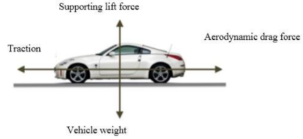
Figure 1. Forces acting on a moving vehicle [3].
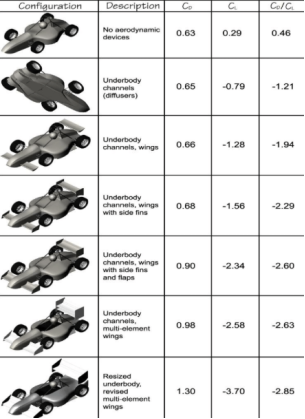
Figure 2. Drag and Lift coefficients of a FSAE car with different aerodynamic packages [11].
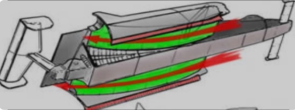
Figure 3. Venturi tunnels in a racing vehicle [15].
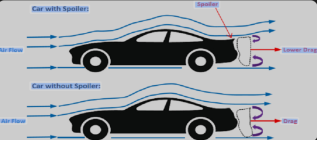
Figure 4. Comparison of airflow over a vehicle with and without a rear spoiler [16].

Figure 5. Side profile of the Tesla Model S in aerodynamic testing [5].
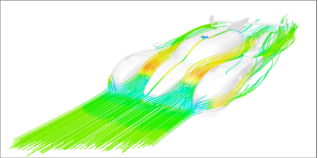
Figure 6. Le Mans Prototype showing streamlines and pressure distribution around the underbody and diffuser regions [7].
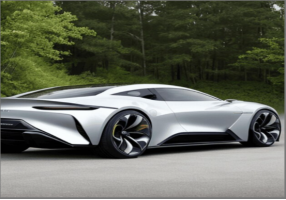
Figure 7. Futuristic concept car with sleek, nature-inspired styling cues [14].




 Share This Article
 Twitter
 Linked In
 Facebook
 Copy
Copy Download